By Marcia Rackow
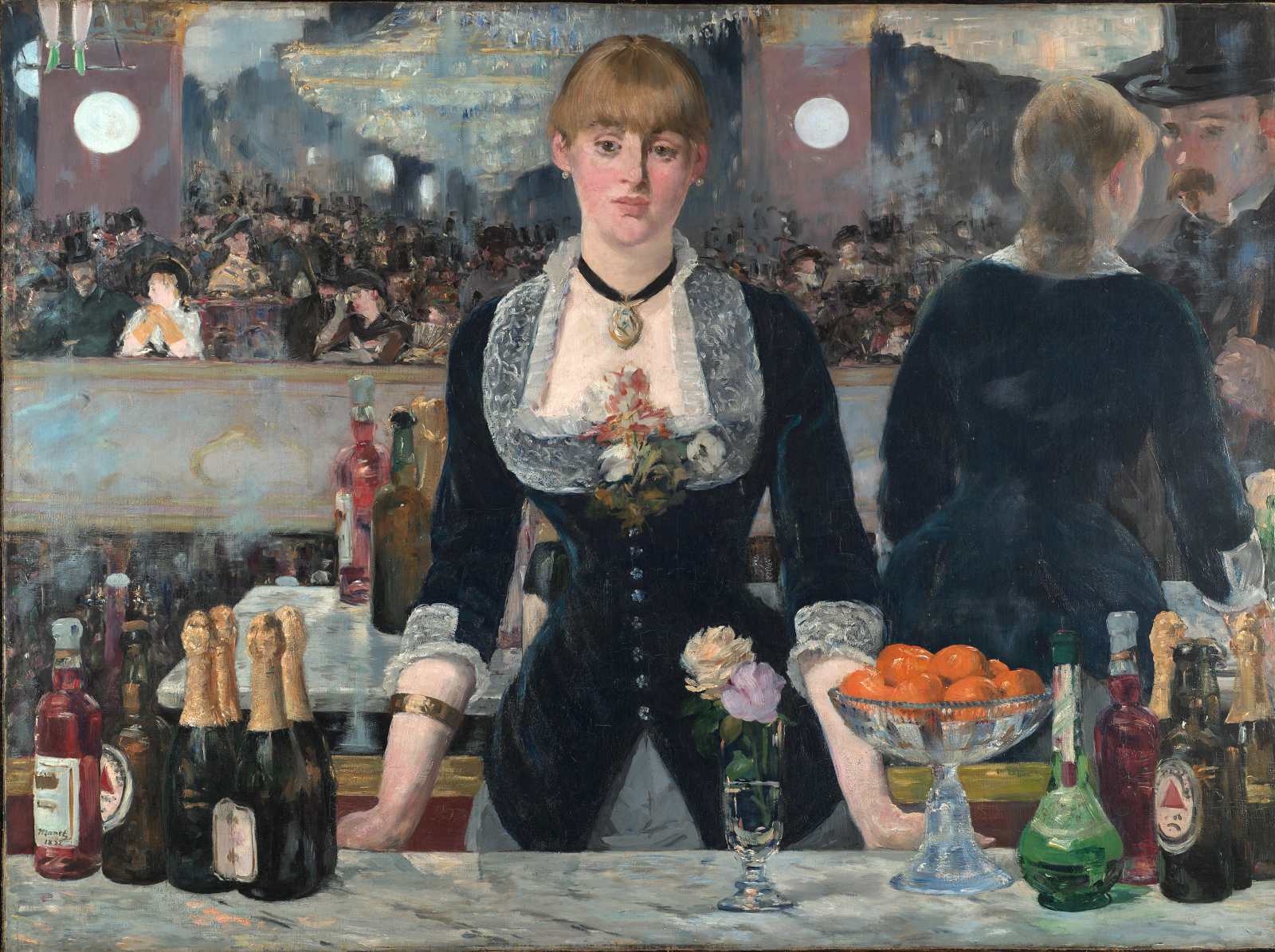
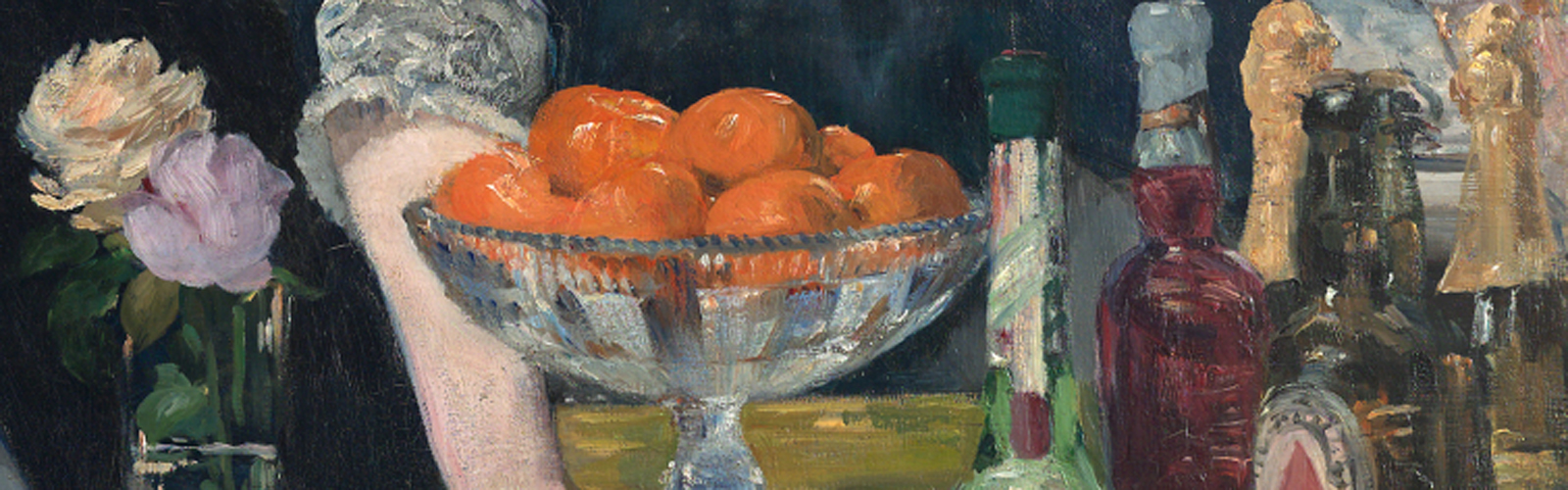
Édouard Manet’s A Bar at the Folies-Bergère is one of the most beautiful paintings I have ever seen.The way Manet paints surfaces is magnificent—a cut glass bowl of shiny tangerines, soft rose petals, golden foil and dark glass, the pale pink of the young woman’s skin, the richness of black velvet, the sparkle of light on crystal, the haze of blue smoke.
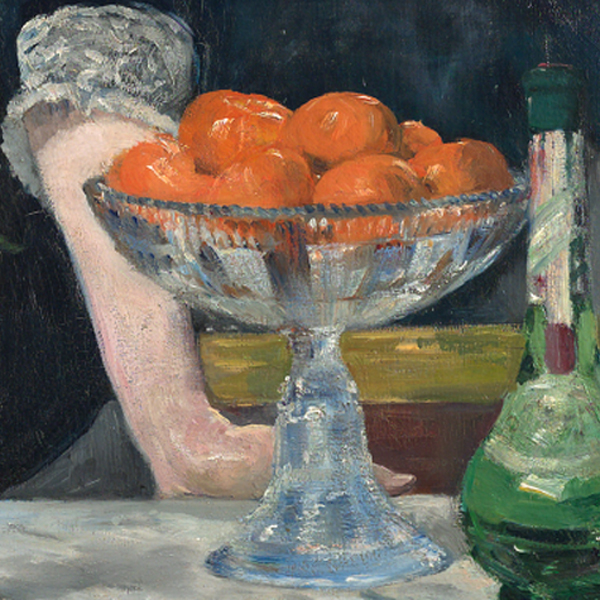
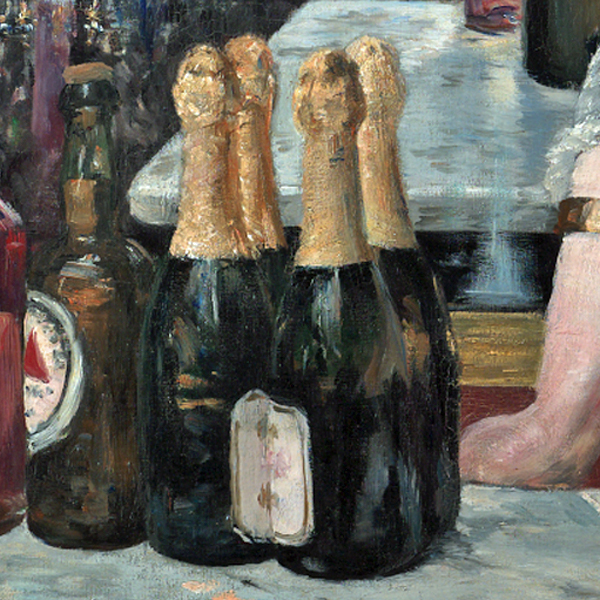
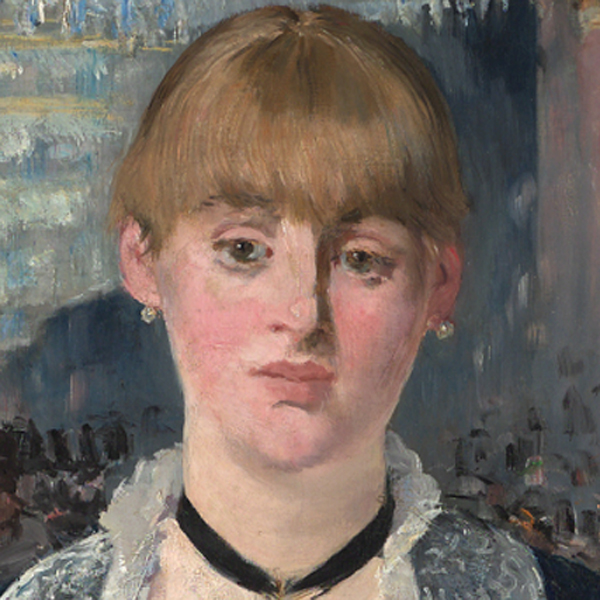
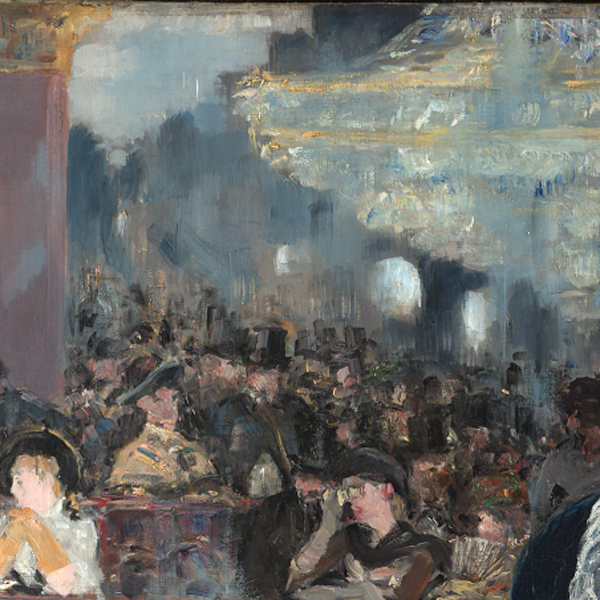
But surface in Manet is not just surface. His surfaces are so intense, we feel they are the same as substance and depth. In his paintings Manet was not using surface to evade the depth of things, as people often do in life; he was revealing it in a new way.
Eli Siegel is the philosopher and critic who explained, for the first time in history, what makes a work of art beautiful, and what it can teach us about ourselves. “All beauty,” he stated, “is a making one of opposites, and the making one of opposites is what we are going after in ourselves.” In this landmark principle is the explanation of what people have tried to understand for centuries: the true relation of art and life.
As a painter, I was very taken by the surface of things, but in my paintings I stayed on the surface—and the objects I painted looked very flat. This troubled me. In my life, I also stayed away from depth. Like most people, I felt the deeper you went into your own thoughts or into the lives of other people, the darker and murkier things were and the sadder you became. So I felt early it was best not to go probing. I thought the way to be happy was to keep on the move, and not be tied down or too involved with anyone or anything. But I wasn’t happy; I was worried about the fact that I wasn’t really close to anyone.
I learned from Aesthetic Realism that not only do surface and depth not have to fight, but that they are really friendly. In an Aesthetic Realism lesson I was honored to have, Eli Siegel asked me:
Do you think that seeing things more deeply and truly will make you happy?…[Most people] think that if they can select—and also whenever it seems proper, to see the surface of things, the agreeable surface—it’s enough.
What Mr. Siegel described and made conscious to me in this lesson changed my life and my work. And when I saw Manet’s painting, I felt the relation of surface and depth as one thing made for such great beauty, I knew I had to study it.
The Depths of a Woman and the World
A Bar at the Folies-Bergère, which Manet painted in 1881, two years before he died, shows the famous Paris nightclub he and his friends frequented. It represents a scene rich with what certainly could be called “the agreeable surface[s] of things.” But it is through surface that Manet shows the depths of a woman and the world.
In Eli Siegel’s historic 15 Questions, Is Beauty the Making One of Opposites?, he asks this great question about Depth and Surface—opposites which are central to the beauty of this painting, and are also opposites women hope to make sense of in their lives:
Is painting, like art itself, a presentation of the “on top”, obvious, immediate?—and is it also a presentation of what is implied, deep, “below”?—and is art, consequently, an interplay of surface and sensation as “this” and depth and thought as “all that”?
This composition is an amazing relation of surface and depth. The actual depth of the scene is very shallow. It takes in the bar and the space behind the bar just up to the surface of the mirror directly behind the woman. Manet emphasizes the flat shallowness of the space by placing the bar parallel to the picture plane.
The young woman faces us directly, though her eyes do not look at us. She is very close, immediate, but that look in her eyes has depth, poignancy, mystery. Manet further compresses the space by accenting the light horizontal bands behind the woman—the reflection of the bar, and the front of the balcony. These bands join visually with the color and shape of the marble bar and come forward to the surface.
There is such immediacy about this girl, and these objects. In my everyday life, I wanted to stand back, aloof, not be too deeply affected by anything. Manet won’t allow it. Yet as he insists on flatness, the depth of the space reflected on the surface of the mirror seems infinite.
Frivolity—and the Mighty
In the Aesthetic Realism lesson from which I quoted, Eli Siegel asked me a question that could be asked of other women: “Do you think you would rather see something, even with your care for painting, as frivolous rather than mighty?” My answer was yes, and I have seen it is the reason I felt I was superficial myself.
This painting of Manet makes a one of the frivolous and the mighty. Art critic Pierre Schneider writes about it in his book The World of Manet:
The girl is young and attractive; the place, the hour, the occasion speak of frivolity, or merrymaking. Yet, there is something strangely solemn.…It has the grandeur of the transcendent and the fragility of the transient. The moment turns into monument. A Bar at the Folies-Bergère is…the summit of Manet’s lifelong endeavor.
Manet has placed the girl right in the middle of the picture, as symmetrically and boldly as a Renaissance Madonna. The line of buttons on her dress continues right up through the center of her body and is the exact center of the painting. As she leans on the bar, her body forms the permanent and stable shape of a triangle. The verticality of her body is like the vertical columns on the balcony behind her and the curved verticals of the bottles below. Together with the horizontal lines of the bar and the balcony, they form a solid structure, an architecture, at one with the smoke and the shimmer of lights.
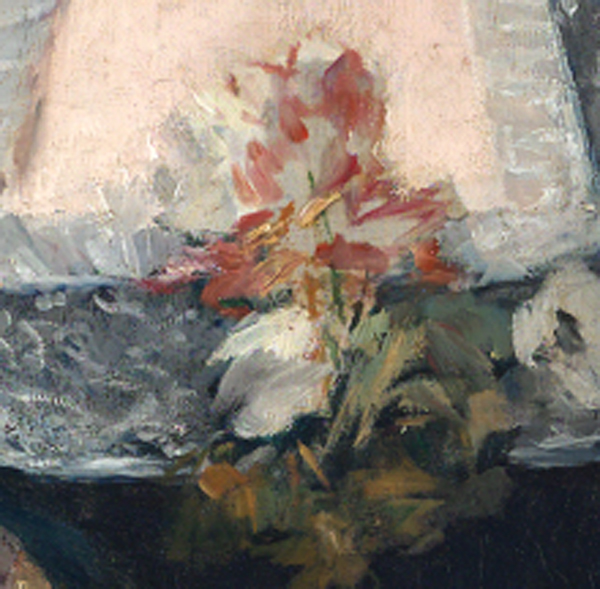 Her corsage of white and orange flowers, which has a lovely frivolity, is placed right against the lacy horizontal line of her bodice and echoes the triangular shape of her body. And so a detail seems to express her whole self.
It is moving to see that Manet has made these flowers, with all their fragility, the central point where the two diagonal axes of the painting intersect. See how there is a line from the bottom right corner, through the tangerines up to the white circle of light at the top left, and a line from the bottles at the lower left up to the face of the man reflected in the mirror at the upper right.
When Manet painted this young woman behind the bar at the Folies-Bergère, he saw one of the deepest relations in the world—the relation of the momentary and the permanent, the “transient appearance of things” at one with the eternal forms, which are the foundation of the world.
“All reality is as deep as any other reality.”
In an Aesthetic Realism class, Mr. Siegel explained to me:
All reality is as deep as any other reality….Anything that exists says something about existence, illustrates existence. You can have a deep feeling about a superficial subject.
Like the French critics who, in 1881, thought the subject of this painting was low and vulgar, I was snobbish about what I saw as important. I divided the world between what I saw as “the higher things” and the “lower things.” I learned from Aesthetic Realism that this is contempt—the “disposition in every person to think we will be for ourselves by making less of the outside world.” Eli Siegel identified contempt as the greatest danger of mind and the greatest interference with and enemy of art.
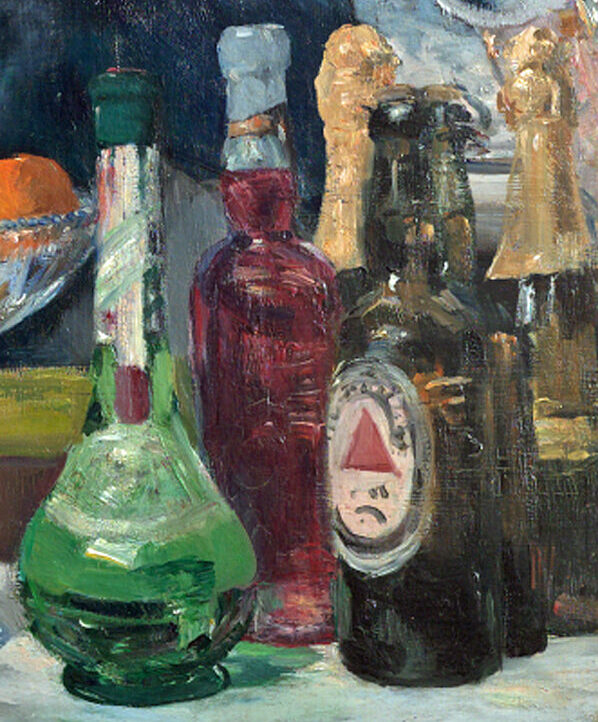
Manet shows, as Mr. Siegel said, “All reality is as deep as any other reality.” He shows the same love and attention in painting the dark glass bottles as he does in painting the dark eyes of the beautiful young woman. Light glimmers throughout the canvas and gives a sense of the equality of objects—the immediacy of all things near and distant, animate and inanimate.
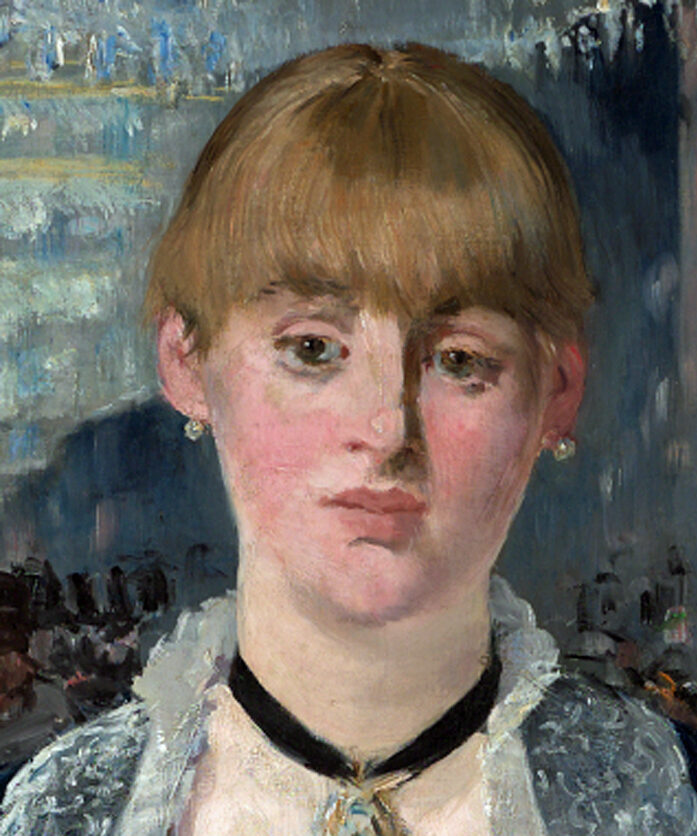
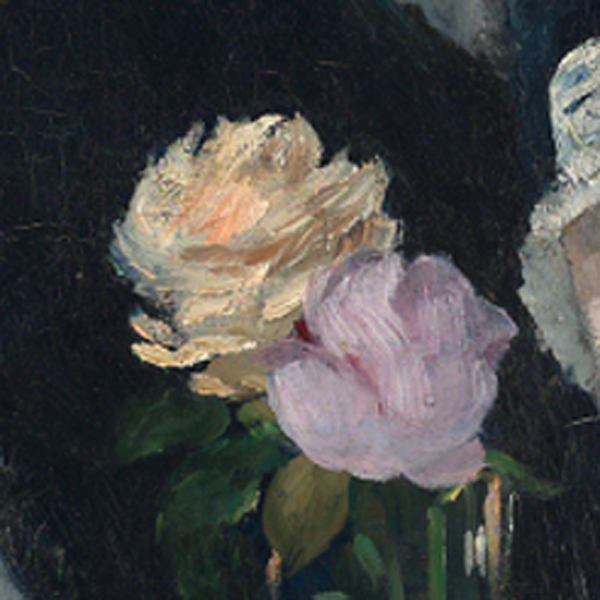
Eli Siegel said in the discussion I just quoted, “A hummingbird is as deep as a graveyard.” In the detail of the full-blown roses in the crystal vase, there is an energy and motion in the daubs and strokes of paint that make the roses seem to flutter. Yet look at the thickness and depth of the paint and the permanency of the large, round shapes felt within the structure of the petals. Manet shows the ephemeral, the delicate, is as deep as that profound black of her dress.
What Is in Her Mind?
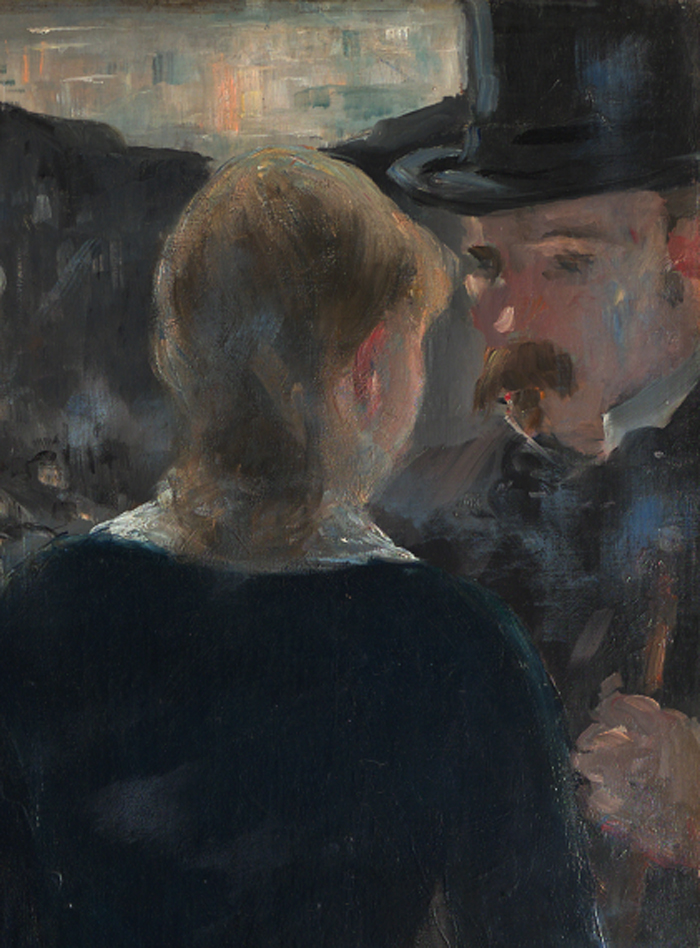
In the mirror behind the young woman we see many surfaces, but we also feel great depth. “As soon as a thing can make for reflection,” Eli Siegel once said, “it is against flatness. Reflections as such are always three-dimensional.” And mind does what a mirror does—it reflects. Surprisingly, the depth in this painting is not what is behind the woman; it is what is in front of her. What we see in the mirror is what she looks out on and is part of her consciousness—the depths of the dance hall, the face of the man at the bar.
Also, the reflections of the figures in the mirror are not exactly where they ought to be. The man would be in front of the woman, and their reflections would not be so far to the right.
“It is a puzzling picture,” wrote Pierre Schneider, “bold and powerful, but disturbingly contradictory. The mirror image seems to defy normal visual perception. The mirror seems to have a reality of its own.” As we look, we can ask, “Is it really a reflection we are seeing, or a reflection of what is in her mind?”
In Self and World Eli Siegel comments on the meaning of a dream where both the front and back of a man were seen simultaneously, as the young woman is seen here. “What is important in the dream,” Mr. Siegel writes,
is that he feels he can face forward and backward; that is, what he shows and what he doesn’t show can exist at the same time. There is a disruption between front and back deep in the unconscious, and what we have here is the same person seeming to be in front and also in back…This is a road to felicitous integration.
Manet may have felt something like this. What joins the two images of the woman—front and back—is the joyous bowl of tangerines, the brightest thing in the painting. In the mirror Manet is making visible an aspect of this woman not usually seen—her possibilities, her hopes, an image of herself and the things in her mind.
As the young woman leans towards the man in the mirror, there is a glow of light around her head, and though we cannot see her face in the reflection, she seems to be looking into the dark eyes of that mysterious man who looks so deeply and intently into hers. Does he represent the unknown world as close and comprehending?
In a Manet exhibition catalogue of 1932, annotated by Eli Siegel, I was very moved when I read the note he made over this painting: “How Being Is There.” Manet shows “Being”—the permanent, abstract form of the world, its depth, its meaning, is there—in those two sharply defined flat circles of white light on the balcony, and in the glittering and opulent show of things: among the bottles, the dazzling chandeliers, the look in a woman’s eyes.
Edouard Manet resplendently shows how surface and depth are inseparably, beautifully one—and this is how every woman wants to see the world and herself. The Aesthetic Realism of Eli Siegel makes this way of seeing a magnificent possibility in every person’s life!