13 LIGHT AND DARK DOES all art present the world as visible, luminous, going forth?—does art, too, present the world as dark, hidden, having a meaning which seems to be beyond ordinary perception?—and is the technical problem of light and dark in painting related to the reality question of the luminous and hidden? —Eli Siegel, from Is Beauty the Making One of Opposites?
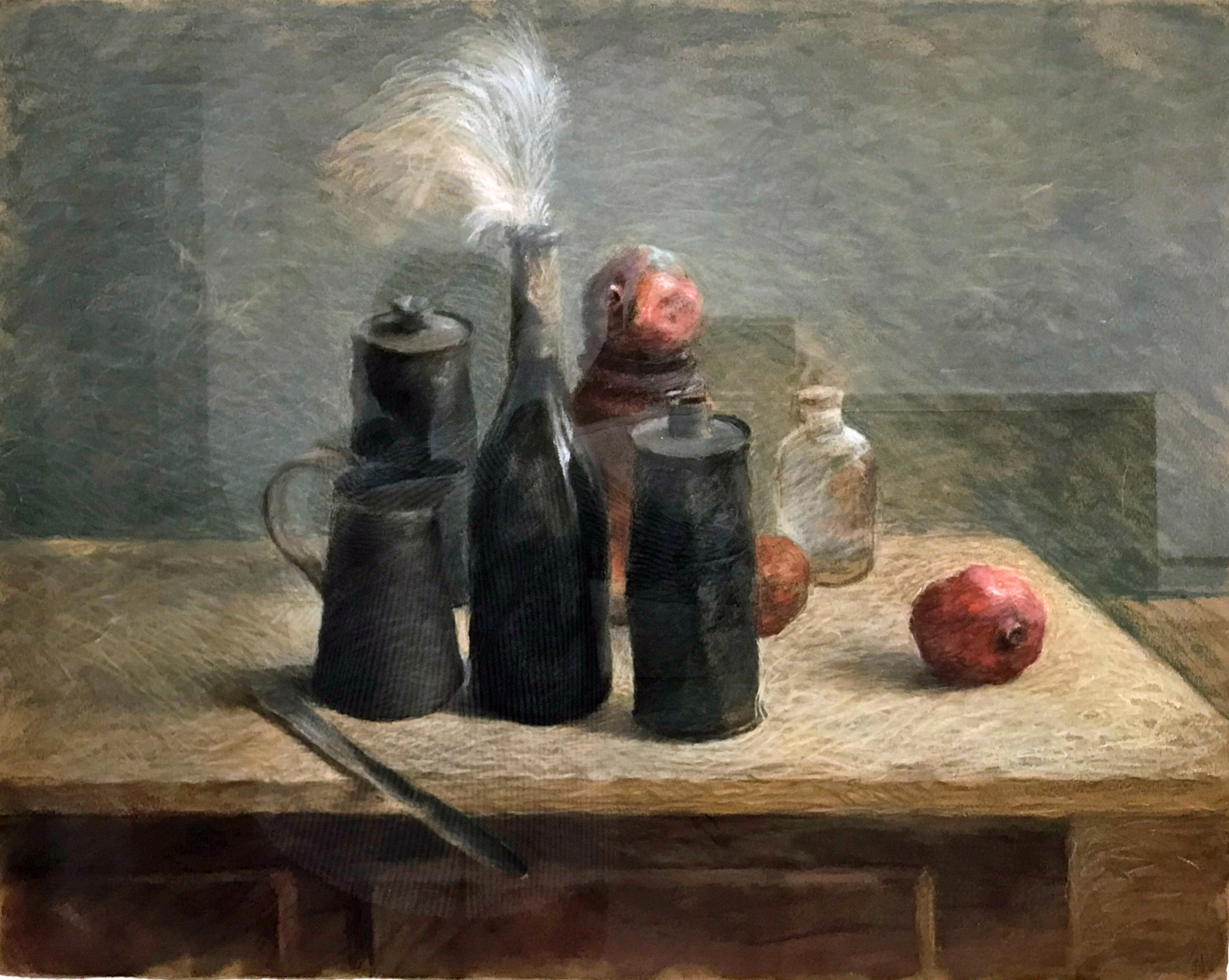
This still life of familiar objects in the artist’s studio is like a group portrait—each item has such individual character. Through the artist’s consummate technique, the substance of every object, from pitcher to pomegranate, is revealed—almost sculpted—through subtle effects of light and shadow.
The tallest object, a wine bottle, nearly black yet gleaming, is crowned, surprisingly, with an exuberant white plume. That beautiful feather, so unexpected and radiant, rises proudly in the midst of these objects, and seems to celebrate their existence.
Below, on the glowing and shadowed table, a diagonal knife extends toward us, bridging the distance between these objects and ourselves. I think it is saying: You are part of this drama of dark and light, too.
As his student and colleague, I know Chaim Koppelman loved these words from Eli Siegel’s Is Beauty the Making One of Opposites?: “Does all art present the world as visible, luminous, going forth?—does art, too, present the world as dark, hidden, having a meaning which seems to be beyond ordinary perception?”
That is what we see in this magnificent still life. —Carrie Wilson
Next: FRANCINE HERNANDEZ, Minuet for Squares
Return to Five Artists & the Opposites