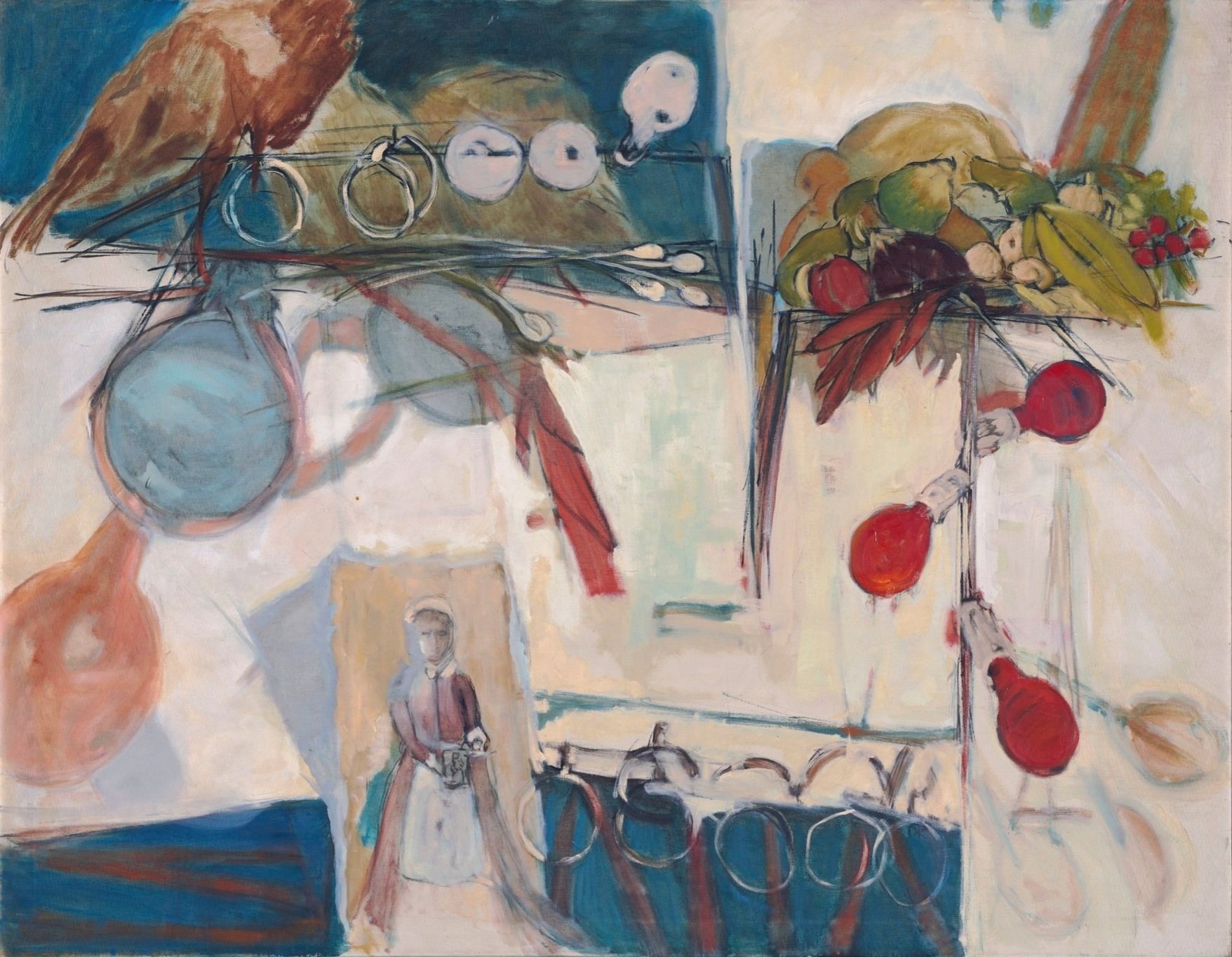
It has been felt for a long time that art, while having its structure, its accuracy and, at times, it’s classicality, should also have something unlooked for, something askew, beautifully awry….The need for the surprising, the out-of-line, the irregular is not a need, only, of an era or period. It is a need of the human mind, in any century or hour. —Eli Siegel, from The Opposites Theory
The “beautifully awry” in this artist’s work was described by Eli Siegel in an Aesthetic Realism class: “Dorothy Koppelman has been much taken by the problem of asymmetry, which means that the world has a tendency to be very irregular….It seems the world is mischievous.”
This surprising array of familiar objects—light bulbs, a postage stamp, a bird—seems mischievously “out-of-line”! Yet they are composed within a structure of white and blue rectangular shapes.
Dorothy Koppelman shakes up our complacency—our taking things for granted or seeing them as separate and unrelated. When was the last time we appreciated the beautiful round form of a light bulb, or the circularity of curtain rings, or saw their relation to a bird’s curved breast, or the graceful image of woman on a stamp? The artist does just that. She shows the “unlooked for” in the ordinary, surprise in the familiar. –Marcia Rackow
Next: JAMES JUTHSTRUM, Untitled 4, and Comment by Dan McClung
Return to Five Artists & the Opposites